
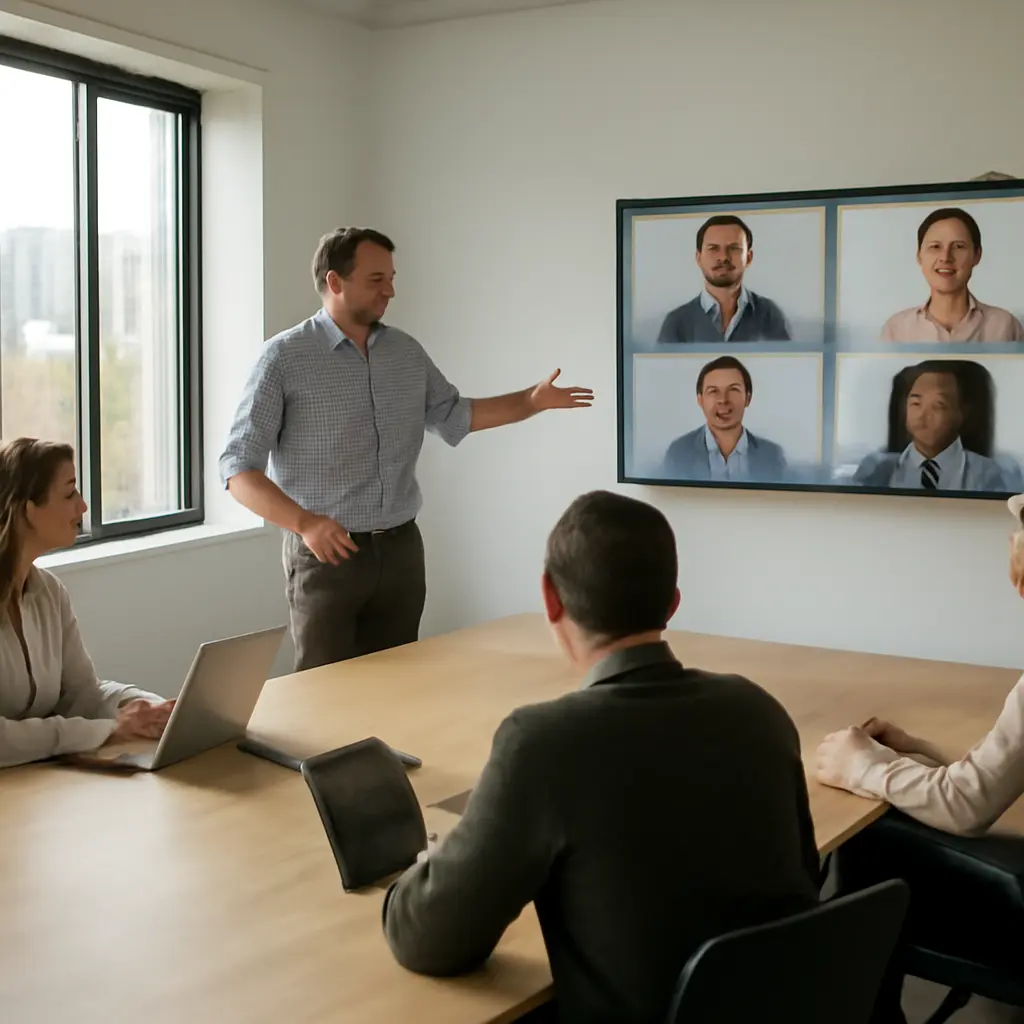
Hybrid workplace leadership is the practice of guiding people who work across office and remote settings through clear expectations, equitable access to information, purposeful communication, and trust. Effective leaders make location less important than contribution: they set measurable goals, include remote employees in decisions, support connection and well-being, and adapt work practices as evidence changes. The stakes are substantial: Gallup’s 2024 workplace research found that 51% of employees able to work remotely were in hybrid arrangements, while 27% were fully remote. This article explains the defining features of hybrid leadership, the behaviors that make it effective, and how organizations can assess and improve their approach.
Defines effective leadership as a hybrid workplace capability
Hybrid workplace leadership is not simply managing people who happen to work in different places. It is the design and practice of coordinating work, relationships, and decisions across locations so employees can contribute under fair and understandable conditions. There is no single universal definition of the term; this article uses it to describe leadership that combines outcome-focused management with intentional communication, inclusion, and support for distributed teams.
The scale of hybrid work makes these capabilities relevant to a broad range of organizations. Gallup’s 2024 State of the Global Workplace reporting found that, among U.S. employees whose jobs could be done remotely, hybrid work was the most common arrangement. Meanwhile, Microsoft’s 2024 Work Trend Index reported that 75% of surveyed knowledge workers used AI at work, a reminder that hybrid leaders must also guide teams through changing tools and workflows. These findings describe different populations and should not be treated as directly comparable, but together they show why leadership needs to address both work design and technology.
Outcome-based management
Outcome-based management evaluates progress through agreed deliverables, quality, and impact rather than visible activity or time spent in the office. Leaders translate organizational priorities into clear team goals, define who owns each task, and agree on how progress will be reviewed. This reduces ambiguity for employees who cannot rely on informal office conversations to learn what matters.
The practice is most effective when goals are specific but not needlessly prescriptive. A team might define a customer-response target, project milestone, or service-quality measure while allowing employees discretion over how to meet it. Leaders should also review whether the measures reward sustainable results: a target that encourages speed at the expense of accuracy or well-being can undermine the purpose of managing by outcomes.
Trust and autonomy
Trust-based leadership gives employees appropriate discretion over where and how they complete their work while maintaining accountability for commitments. It does not mean withdrawing support or avoiding performance conversations. Instead, leaders make expectations explicit, provide resources, and address obstacles without using constant monitoring as a substitute for management.
This matters because remote visibility can be misleading: a person’s online status does not reliably indicate the value or quality of their work. Organizations should use proportionate, transparent measures and explain what data is collected and why. Clear norms help prevent surveillance practices from eroding trust, especially when employees work across different schedules or locations.
Once goals and accountability are clear, leaders need communication practices that keep distributed employees informed and connected.
Builds communication and inclusion into hybrid leadership
Communication in a hybrid workplace is the deliberate exchange of information through channels and routines that allow employees to understand decisions, coordinate tasks, and raise concerns regardless of location. Inclusion is the related practice of ensuring that access to information, participation, recognition, and opportunity does not depend on being physically present. These are connected leadership responsibilities: communication systems shape whose contributions are heard.
Microsoft’s Work Trend Index has described a “digital debt” problem: the growing volume of messages, meetings, and notifications can make it harder for employees to focus. The implication is not that teams should communicate less in every situation, but that leaders should select the right channel and make important information easy to find. A written decision log, for example, can prevent employees who missed a meeting from being excluded from the outcome.
Deliberate channel and meeting design
Channel design means matching the communication method to the task. Teams can use shared written documents for decisions and reference material, messaging for short coordination, and meetings for discussion that benefits from real-time exchange. Leaders should clarify response-time expectations and protect focused work by avoiding unnecessary calls and after-hours messages.
Meeting equity requires more than adding a video link. When some participants are in a conference room and others join remotely, leaders can make the experience fairer by ensuring remote attendees can see and hear the discussion, inviting their input directly, sharing materials in advance, and recording decisions and action items. For meetings that do not require live debate, an asynchronous update may be more accessible across time zones and caregiving schedules.
Equitable visibility and opportunity
Equitable visibility means that employees’ contributions and development needs are recognized on the basis of their work rather than their proximity to managers. Leaders can support it by documenting project ownership, using consistent performance criteria, and ensuring remote employees receive access to mentoring, high-impact assignments, and promotion discussions.
A practical check is to compare outcomes across work arrangements: who receives stretch assignments, who is invited to key meetings, and who advances? Differences do not automatically prove bias, but they can signal a need to examine how decisions are made. The same review can identify whether office-based employees receive informal advantages simply because they encounter leaders more often.
Psychological safety and employee voice
Psychological safety is a shared belief that people can ask questions, admit mistakes, and offer concerns without fear of humiliation or retaliation. In hybrid teams, leaders need to create explicit opportunities for input because spontaneous conversation is less available to remote employees. They can invite dissent before finalizing decisions, offer one-to-one check-ins, and respond constructively when someone identifies a problem.
Google’s Project Aristotle, an internal study of team effectiveness, identified psychological safety as a central characteristic of effective teams. The finding is a useful organizational case, not proof that one leadership practice guarantees performance in every workplace. Its practical lesson is that teams need conditions in which members can contribute candidly—whether they are in the office or joining from elsewhere.
Inclusive communication helps employees participate, but sustained effectiveness also depends on designing work that supports connection, learning, and well-being.
Supports well-being, collaboration, and development
Well-being-oriented hybrid leadership organizes work so employees can meet expectations without unnecessary strain or isolation. It includes realistic workloads, clear boundaries, accessible support, and opportunities to build relationships. Collaboration and development are part of the same system: employees need both focused time to deliver work and structured occasions to learn from colleagues.
The World Health Organization and International Labour Organization have emphasized that telework can benefit workers and employers when it is properly organized, while also identifying risks such as isolation and blurred boundaries between work and home. Leaders should therefore treat well-being as a work-design issue, not merely an individual resilience problem.
Connection and team cohesion
Team cohesion is the sense of shared purpose and dependable connection that helps people coordinate and support one another. Hybrid leaders can strengthen it through purposeful in-person gatherings, structured peer learning, regular team retrospectives, and accessible informal spaces online. Office attendance is most useful when employees understand why they are gathering—for example, to solve a complex problem, build relationships, or onboard new colleagues.
A 2023 study published in Nature by researchers examining employees at Trip.com found that a hybrid schedule of two work-from-home days per week improved job satisfaction and reduced quit rates, without damaging performance reviews or promotion outcomes over the study period. This is a notable company-specific randomized study, not a guarantee that the same schedule will suit every role or organization. It illustrates why employers should test work arrangements against relevant outcomes instead of relying on assumptions about office presence.
Boundaries and sustainable workload
Boundary-supportive leadership makes it possible to disconnect from work and recover. Leaders can set reasonable communication windows, discourage routine after-hours messages, monitor workload distribution, and model the use of leave. They should also distinguish flexibility from permanent availability: the ability to work from home does not mean employees should be reachable at all times.
The International Labour Organization has noted that telework arrangements need clear agreements about working time, equipment, communication, and health and safety. These details matter because employees’ home environments and personal responsibilities differ. A clear policy gives managers a consistent foundation while allowing reasonable accommodation for individual circumstances.
Coaching, onboarding, and career growth
Hybrid coaching is the ongoing practice of helping employees build skills and judgment through feedback, goal-setting, and access to learning. New employees often need more intentional onboarding because they may not absorb workplace norms through casual observation. Leaders can assign a peer mentor, document key processes, schedule early check-ins, and provide a clear path for asking questions.
Career development should also be visible and location-neutral. Managers can discuss growth goals regularly, explain promotion criteria, and ensure remote employees are considered for challenging work. Reviewing participation in training and the distribution of high-profile assignments can help identify gaps before they become persistent career disadvantages.
These practices become more reliable when leaders measure whether they are working and adjust them using employee feedback and operational evidence.
Measures and improves hybrid workplace leadership
Measurement in hybrid leadership is the regular assessment of work outcomes and employee experience across locations. Effective measurement combines organizational indicators—such as quality, delivery, customer outcomes, and retention—with evidence about inclusion, workload, and communication. No single metric can capture leadership effectiveness, and comparisons should account for role, team, and business context.
Use a balanced set of indicators
A balanced dashboard can include project completion and quality, customer satisfaction, employee engagement, absenteeism, turnover, meeting load, promotion patterns, and access to development. Leaders should compare results by team and work arrangement where sample sizes and privacy protections permit. The purpose is to find patterns and improve work—not to rank employees by online activity.
A simple textual scorecard could group indicators into four areas: results (delivery and quality), inclusion (participation and opportunity), well-being (workload and recovery), and capability (learning and development). Reviewing these together can reveal trade-offs that a productivity-only measure would miss.
Learn through pilots and feedback
A pilot is a limited test of a policy or work practice before it is adopted more broadly. Organizations can test meeting-free focus blocks, team anchor days, or new onboarding routines, then evaluate the results against agreed criteria. Employee surveys, listening sessions, and operational data provide complementary evidence; leaders should explain what changed in response to feedback so consultation feels consequential.
The Trip.com study offers an example of evaluating hybrid arrangements with measured outcomes rather than assumptions. Its results support careful experimentation, while its setting also cautions against treating one company’s schedule as a universal prescription. The appropriate arrangement depends on the work, employee needs, legal obligations, and organizational goals.
Establish clear policies and manager capability
Policies provide a consistent framework for eligibility, scheduling, equipment, security, accessibility, and communication expectations. They should be clear enough to reduce arbitrary decisions while allowing managers to respond to legitimate role requirements. Training helps managers apply these policies consistently, conduct effective remote conversations, recognize proximity bias, and address performance concerns with evidence.
A policy alone cannot create effective hybrid leadership. Senior leaders must model the norms they expect—such as documenting decisions, respecting time boundaries, and evaluating results fairly—and revisit arrangements when data or employee feedback shows they are not working.
Conclusion: Make leadership effective across locations
Effective hybrid workplace leadership combines outcome-based management and trust with inclusive communication, equitable opportunity, well-being, and evidence-informed improvement. Clear goals help distributed teams coordinate; intentional meeting and communication practices ensure people can participate; sustainable work design supports connection and development; and balanced measures show whether policies deliver fair, effective results.
Hybrid work is not a single schedule or technology choice. It is an ongoing leadership challenge shaped by the needs of employees, the nature of the work, and organizational priorities. Leaders can begin by reviewing how decisions are documented, whether remote employees have equal access to opportunity, and which outcomes best represent success. Then they can test improvements, share what they learn, and adjust practices with employees’ experience and business evidence in view.
Sources: Gallup, State of the Global Workplace: 2024 Report, https://www.gallup.com/workplace/349484/state-of-the-global-workplace.aspx; Microsoft, 2024 Work Trend Index Annual Report, https://www.microsoft.com/en-us/worklab/work-trend-index/2024; Google re:Work, Understand Team Effectiveness, https://rework.withgoogle.com/intl/en/guides/understand-team-effectiveness; Bloom, Nicholas, Ruobing Han, and James Liang, “How Hybrid Working From Home Works Out,” Nature, 2023, https://www.nature.com/articles/s41586-024-07500-2; World Health Organization and International Labour Organization, Healthy and Safe Telework: Technical Brief, 2021, https://www.who.int/publications/i/item/9789240040977; International Labour Organization, Working from Home: From Invisibility to Decent Work, 2021, https://www.ilo.org/publications/working-home-invisibility-decent-work.


